Release for consumption




Joint actions
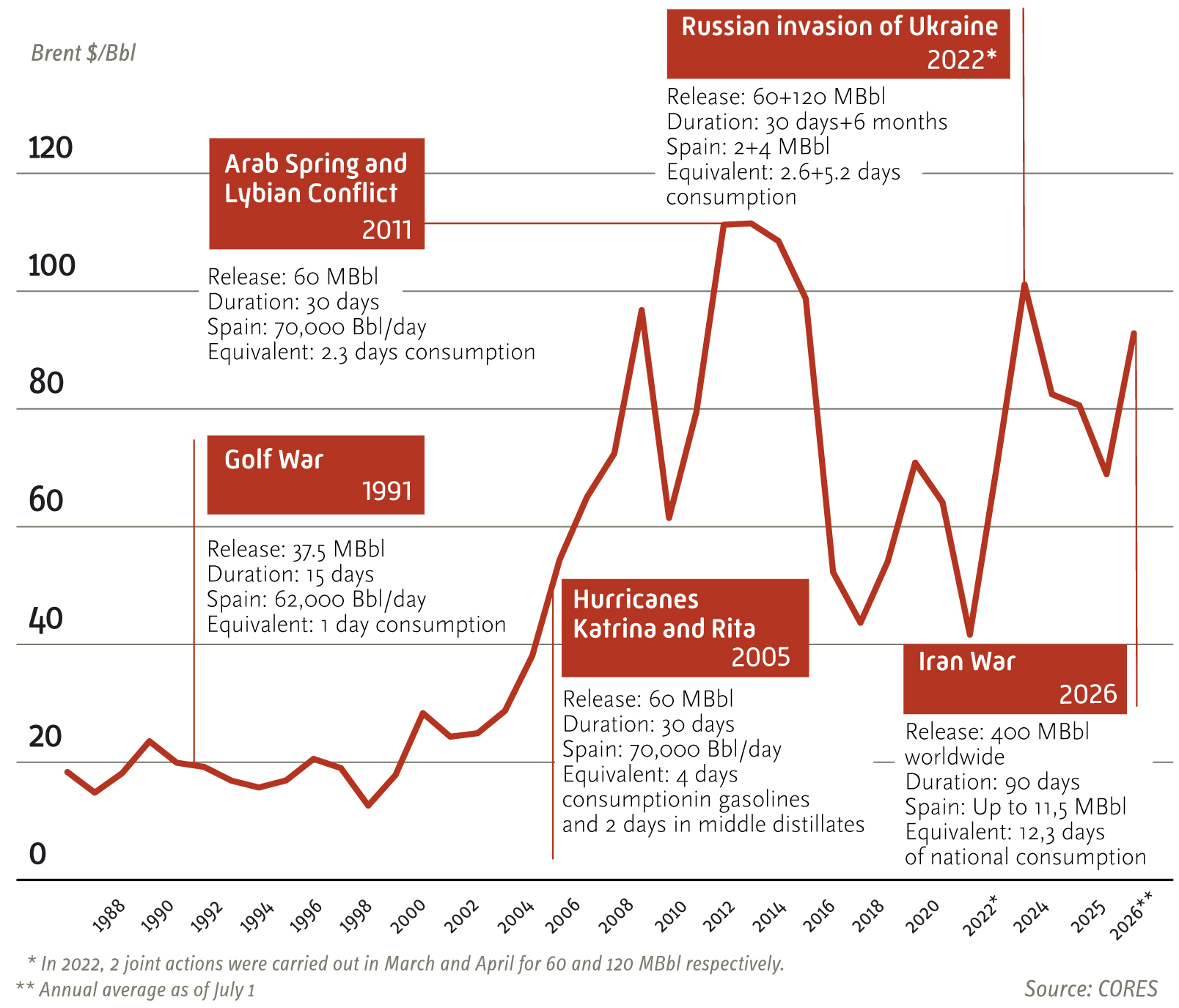
In the context of the war in Iran and the blockade of the Strait of Hormuz to oil tankers, on March 11, 2026, with the aim of contributing to market stability, mitigating potential supply tensions, and moderating the impact of price volatility on economies and consumers, the International Energy Agency (IEA) agreed to activate an emergency collective action consisting of the coordinated release of strategic reserves of crude oil and petroleum products, totaling 400 million barrels over 90 days, which will be made available to the market in different phases depending on the circumstances of each member state.
In line with its commitment to coordinated international action and as authorized by the Council of Ministers on March 17, 2026, Spain will contribute up to 11.5 million barrels of oil, 2.9% of the total, equivalent to 12.3 days of national consumption.
In an initial phase, a volume equivalent to four days of consumption—to be released onto the market over a 15-day period—will be made available by the obligated parties referred to in Article 7 of Royal Decree 1716/2004. The next steps will depend on how events unfold. This measure takes effect as specified in the Resolution published in Spain's Official State Gazette (BOE).
This is the sixth time that IEA Member Countries have taken emergency collective action to support oil markets in the history of the IEA.
Other joint actions
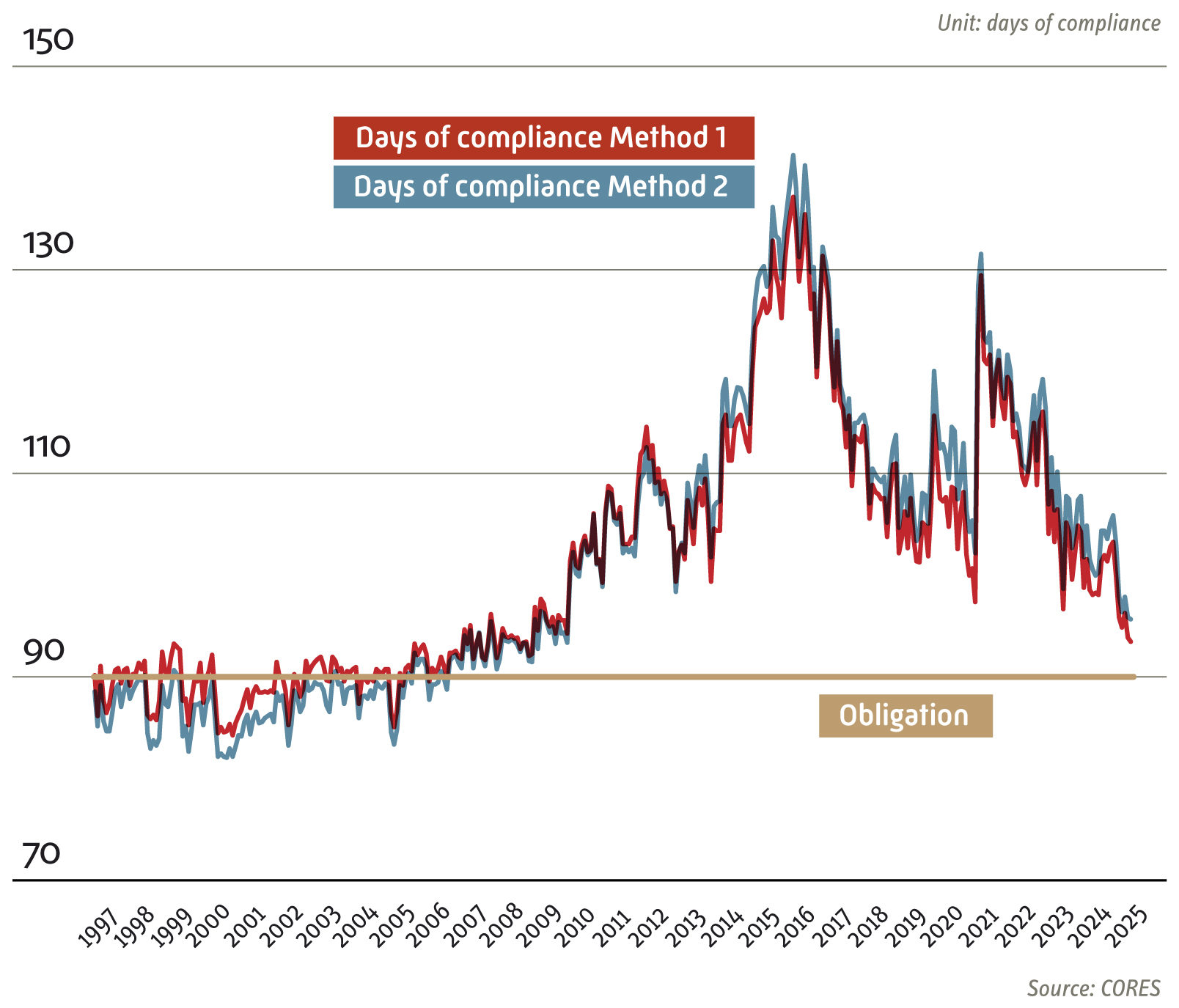
The International Energy Agency (IEA) was created in 1974 after the oil crisis as an independent body within the OECD, with the aim of coordinating the policies of its members countries in the event of a disruption in the supply of crude oil and petroleum products, both at national and international levels. The IEA requires its members to hold reserves equivalent to at least 90 days of oil imports.
If the IEA identifies a supply crisis, it may promote a joint action consisting of making available to the market a specified volume of oil reserves (this volume being calculated according to the specific circumstances) by each member country, in order to increase the availability of crude oil and petroleum products. Each State may determine the way in which such stocks are released for consumption.
In addition, member countries may opt to establish demand restriction measures, which would lead to a reduction in consumption. Finally, those countries that have domestic oil production may increase their output.
The three joint actions carried out in 1991 (Gulf War), 2005 (Hurricanes Katrina and Rita), and 2011 (Arab Spring and the Libyan conflict) were implemented in the case of Spain were implemented by the release for consumption of petroleum product reserves held by the industry.
The war between Russia and Ukraine in February 2022 prompted the activation by the IEA of two Coordinated Response Plans, which resulted in the release of 60 and 120 million barrels (MBbl) onto the market. Overall, Spain contributed 2 MBbl and 4 MBbl, respectively, which temporarily reduced the minimum security stock maintenance obligation for obligated parties (industry reserves) by a total of 7.8 days.
Russian invasion of Ukraine
The instability in international crude oil and petroleum product markets caused by the invasion of Ukraine led to the activation of the following measures:
The first IEA Coordinated Response Plan, dated March 1, 2022, injected a total of 60 million barrels of oil (MBbl) into the global market, of which Spain released 2 MBbl from its minimum security stocks. This measure was set out in Order PCM/153/2022, which published the Agreement of the Council of Ministers of March 4, whereby the maintenance obligation was temporarily reduced from 92 to 89.4 days, decreasing the requirement for obligated parties by 2.6 days. The released reserves were to be placed on the market within 30 days.
The risk of an even more severe disruption to European energy supplies led to the activation of the IEA's second Coordinated Response Plan on April 1, 2022, which provided for an additional release of 120 MBbl. Under the Resolution of June 1, 2022, which published the Agreement of the Council of Ministers of May 17, Spain committed to contributing 4 MBbl, to be released progressively by the obligated entities. The amount of reserves to be released represented 5.2 days, reducing the total obligation to 84.2 days. The gradual introduction into the market of the released stocks was to be completed within a maximum period of four months, structured in two phases:
- Order TED/553/2022, of 16 June, temporarily reduced the stockholding obligation for the obligated entities by 3 days (equivalent to 2.3 MBbl), lowering it from 89.4 to 86.4 days. This reduction in the obligation was accounted for within the minimum security stocks held by the obligated entities themselves. The introduction into the market of the released stocks had to follow the framework set out in the Agreement of 17 May.
- Order TED/725/2022, of 27 July, temporarily reduced the obligation for the obligated entities, as from 1 August, by an additional 2.2 days, equivalent to a total volume of 1.7 MBbl. Consequently, the obligation was temporarily reduced from 86.4 to 84.2 days. This reduction was likewise accounted for in the reserves held by the obligated entities themselves, maintaining the same timeframe for release into the market as previously established in the Agreement of 17 May.
In all these cases, in Spain, reserves were released based on industry reserves.
The EU also provides for these measures in coordination with the IEA under its Directive 2009/119/EC.
Each IEA member country must have a National Emergency Strategy Organization (NESO), which allows the government to react quickly to a supply crisis by coordinating emergency operations with industry.
The Spanish NESO is part of the Spanish emergency structure, whose ultimate responsibility lies with the National Security Council, according to Law 36/2015 of September 28 on National Security. The National Security Department is the permanent advisory body that coordinates the relevant agencies in the event of a crisis.
In the event of a supply crisis, the Directorate-General for Energy Policy and Mines, together with CORES, would play an significant role in providing technical support for the implementation of specific measures and coordinating the necessary actions with operators.
Release of Cores’ stocks
Law 34/1998, of 7 October, on the Hydrocarbons Sector, provides that, in situations of supply shortage, the Council of Ministers may, by means of a formal resolution, adopt measures intended to ensure the supply of the petroleum market, including the intervention of minimum security stocks, including strategic reserves, which shall be placed under the direct control of CORES.
As a result of the general power cut that occurred in Spain on April 28, 2025, and in order to avoid a possible shortage of petroleum products in the national territory, the Resolution of April 29, 2025 was approved, publishing the Agreement of the Council of Ministers regarding the release of minimum security stocks belonging to the obligated entities and CORES, with a temporary reduction of the obligation by 3 and 4 days, respectively, for the product groups of road and aviation gasoline, and road diesel, other diesel, aviation kerosene, and other kerosene.
Finally, Order TED/533/2025, of May 27, reinstated the obligation for CORES to maintain strategic stocks as of May 31, 2025, and minimum safety stocks for obligated parties as of January 1, 2026. In this manner, the obligation of 92 days established in Royal Decree 1716/2004, of 23 July, was restored. Further information may be consulted here.
In cases such as this, CORES monitors the release for consumption of minimum security stocks, periodically reporting to the Ministry for Ecological Transition and Demographic Challenge through the established channels. CORES, in accordance with its internal procedures, may request from the obligated parties any information it deems appropriate for the proper monitoring of the release of stocks that may be necessary due to national or international requirements.